
Governance and decision making
Good governance is the foundation of effective local government. It ensures decisions are made transparently, accountably and in the best interests of the community.
As a Councillor, you are part of the governing body of the City of Clarence and share responsibility for setting the strategic direction of the organisation, overseeing performance and ensuring resources are used responsibly. Good governance relies on elected members working collaboratively, acting ethically, complying with legislative requirements and maintaining a clear distinction between governance and operational responsibilities.
Effective governance is supported by a range of frameworks, including:
- Local Government Act 1993
- Local Government Code of Conduct
- City of Clarence policies and strategic plans.
Together, these guide how decisions are made, how risks are managed and how accountability is maintained.
How decisions are made
The City of Clarence makes decisions through a formal governance process. While individual Councillors contribute their views, authority rests with the elected Council as a whole, not with individual elected members.
Most decisions are made through resolutions at Council or committee meetings.
Prior to a decision being made, Councillors are provided with reports, recommendations and supporting information to assist you in considering the matter. Councillors are expected to review the available information, participate in discussion and make decisions based on evidence, professional advice, legislative requirements and the best interests of the community.
When making decisions, Councillors should:
- consider all relevant information before them
- keep an open mind until all information has been considered
- focus on the merits of the matter being discussed
- consider the long-term interests of the community
- act in accordance with relevant legislation, policies and codes of conduct
- respect the collective decision-making process.
Once a decision has been made by Council, it becomes the decision of the elected body, regardless of individual voting positions. The administration is then responsible for implementing the decision in accordance with Council’s resolution.
Understanding and respecting this collective decision-making process is fundamental to effective local government and good governance.
Meeting procedures and protocols
Council meetings are where the elected body formally considers matters and makes decisions on behalf of the City of Clarence. To ensure meetings are conducted consistently, fairly and efficiently, they are governed by the council’s Consolidated Meeting Procedures.
The procedures establish the rules and protocols for Council and committee meetings, including how meetings are convened, conducted and recorded. They also outline the rights and responsibilities of Councillors, the Mayor, committee members and members of the public who participate in council meetings.
Key areas covered by the procedures include:
- the scheduling and convening of Council and committee meetings
- annual meeting schedules and notice requirements
- agenda and minute preparation, circulation and publication
- weekly briefing reports and information provided to Councillors
- the order of business and conduct of meetings
- the role of the chairperson and meeting protocols
- requirements relating to quorum and attendance
- open and closed meetings
- pecuniary interests and meeting participation
- motions, amendments and procedural motions
- debate, points of order and meeting conduct
- voting procedures and the recording of decisions
- questions from Councillors and members of the public
- deputations and petitions to Council
- recording and publication of Council meetings.
When participating in meetings, Councillors are expected to act respectfully and professionally, addressing remarks through the Chairperson and following the procedures that govern debate and decision-making. These protocols help ensure all Councillors have the opportunity to participate fairly and that meetings remain focused, orderly and productive.
Councillors should familiarise themselves with the Consolidated Meeting Procedures early in your term, as they provide the framework for how Council conducts its formal business and exercises its decision-making authority.
The basis of the Consolidated Meeting Procedures is the Local Government (Meeting Procedures) Regulations 2025
Livestream
Open ordinary or special Council meetings are livestreamed and recorded on council’s Youtube channel. A link to the recorded meeting is subsequently uploaded to the council website.
Meeting schedules and expectations
Council meetings are an important part of your role as a Councillor and provide the forum through which Council makes decisions and exercises its authority. The schedule of Council meetings is adopted by Council every two years – once after an election has concluded and again mid-way during the term. The annual schedule can be viewed online.
Councillors are expected to:
- review agendas and reports before meetings – these are provided on the Wednesday prior to the scheduled council meeting. Agendas and minutes are also published publicly on our website at least four business days before a meeting.
- comply with meeting procedures and legislative requirements.
Being prepared and actively participating in meetings supports effective decision-making and good governance.
Different meeting types
Councillors participate in a range of meetings that support effective governance, decision-making, and community representation. To carry out your role successfully, you should be familiar with the purpose, procedures, and requirements of each meeting type.
- Ordinary meetings are the regular meetings of the Council where the core business of council is conducted. See – Council meetings.
- Special meetings are convened for a particular purpose by the Mayor, a majority of Councillors or by resolution at a Council meeting.
- Committee meetings oversee specific functions, projects or programs. Depending on their purpose and authority, committees and working groups may include Councillors, council officers, community representatives or subject matter experts. While committees and working groups can make recommendations and provide advice, authority to make decisions generally remains with Council unless specific powers have been formally delegated. Councillors appointed to these groups are expected to actively participate, contribute constructively and report back to Council where appropriate.
- Open meetings are Council meetings that are open to the public unless the topic for discussion is about a matter that may need to be kept confidential.
- Closed meetings are closed to the public under certain circumstances, for a specific reason.
- Annual General Meeting is convened to present the council’s Annual Report.
- Workshops are scheduled as an opportunity for Councillors to receive briefings from council officers, ask questions and discuss matters in a collaborative environment. They are not decision-making meetings. No resolutions are made, and no formal decisions are taken at a workshop. Any matter requiring a decision must be considered and resolved at a formal Council or committee meeting. Councillors are encouraged to actively participate in workshops, as they provide valuable opportunities to build knowledge, seek clarification and prepare for informed decision-making.
Delegations
Delegation means the assignment of authority by the Council to a person, committee, or other authorised body to exercise specified powers or perform designated functions.
To support the efficient operation of the City of Clarence, Council delegates certain powers, functions and duties to the Chief Executive Officer who may further delegate authority to council officers.
Delegations enable routine operational and administrative matters to be managed efficiently without requiring a formal Council decision in every instance. All delegated powers must be exercised within the scope of relevant legislation, Council resolutions and any conditions applying to the delegation.
As a Councillor, it is important to understand that a delegated decision has the same legal effect as if it had been made by Council itself. Individual Councillors do not have the authority to direct staff in the exercise of delegated powers or to intervene in operational decisions made under delegation.
While Council retains responsibility for strategic leadership, policy setting and oversight, delegated authority allows the administration to carry out day-to-day operations and functions and implement Council’s decisions effectively.
See Understating our Organisation.
Policy
Councillors play a key role in developing, considering, adopting, and reviewing policies that establish the strategic direction and governance framework for the organisation. These policies guide how the City exercises its powers, delivers services, makes decisions, and meets its legislative obligations, ensuring decisions are fair, transparent, consistent, and aligned with the council’s strategic objectives.
Policies are adopted by the elected Council and generally address matters that affect the community, governance, service delivery, or the exercise of statutory functions. In contrast, internal (operational) policies are approved by the Chief Executive Officer to guide the day-to-day management of the organisation, including administrative procedures, workforce matters, operational practices, and internal business processes.
Operational policies support the implementation of Council decisions but do not require Council approval unless legislation or the Council has determined otherwise.
This distinction enables Councillors to focus on strategic leadership and policy direction, while the CEO is responsible for managing the operations and implementing the policies adopted by the Council.
Strategic financial governance
Clarence must be able to fund the projects it has planned for and ensure that it is financially viable into the future.
While the day-to-day management of a council’s finances and the budget lies with the council’s Head of Finance (chief financial officer), Councillors are accountable for the long-term financial planning, budgeting and monitoring of the council’s financial performance.
Financial activities need to be underpinned by appropriate plans and strategies, some of which form part of a legislative framework. This ensures that in the long term, assets and services will be maintained in a sustainable way and at a level acceptable to the community.
Clarence maintains a significant suite of infrastructure assets including roads, stormwater infrastructure, buildings, parks and recreational facilities. In considering future funding requirements, Council must reflect on how much funding it will have over the next 10 years and whether the available funding is sufficient.
Integrating strategic asset management and long-term financial plans help guide and improve current and future council performance.
Long term Financial Management Plan
Our long term financial management plan (LTFMP) is a guiding document that is reviewed annually and considered when developing council’s Annual Plan and budget. The LTFMP forecasts council’s financial position in future years and is an important component of council’s financial management framework.
Asset Management Strategy
The Clarence Asset Management Strategy enables Clarence to show how its assets will meet the services needed by the community in a cost effective manner and ensure the integration of asset management with the Clarence strategic and long term financial management plans.
Strategic and corporate planning and reporting
Under Section 66 of the Local Government Act 1993 Clarence must prepare a 10-year strategic plan for the municipality in consultation with the community.
The City of Clarence Strategic Plan 2025–2035 sets the long-term direction for our organisation and provides the framework that guides corporate planning and reporting, including the Term Plan, Annual Plan and Annual Report.
The vision and strategic focus areas in the Clarence Strategic Plan guide Council decision-making, priorities and investment. When Clarence reports on progress and performance, such as through quarterly reports and the Annual Report, Council is able to demonstrate transparency and accountability to the community.
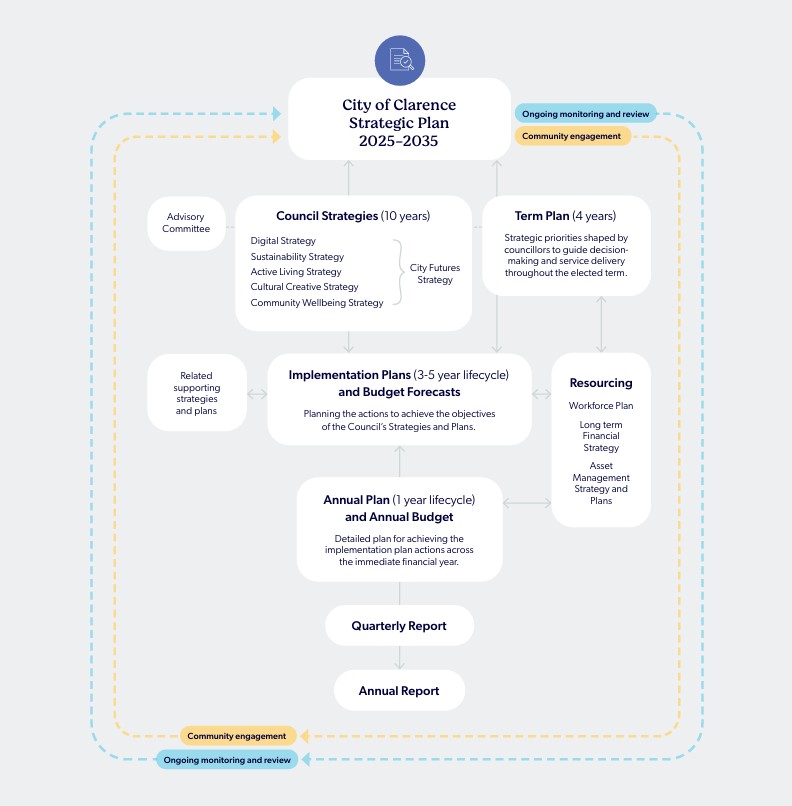
Corporate planning – general
Council develops a range of planning documents, including master plans, structure plans, strategies and implementation plans, to guide the delivery of projects and services for the community.
Corporate planning is the process of bringing these plans, community engagement, financial resources and organisational priorities together to ensure they are aligned and collectively support the achievement of the City of Clarence Strategic Plan. It involves the whole organisation and provides a framework to allocate resources, monitor and measure performance, and maintain transparency and accountability to our community.
Term Plan
The Term Plan is the four-year delivery program for the elected Council term. It translates the Strategic Plan 2025–2035 into a focused set of priorities and actions, guiding council’s annual planning, budgeting and reporting throughout the Council term.
Annual Plan
The Annual Plan is prepared every year to explain how council prioritises its resources to achieve the strategic outcomes contained in the Strategic Plan. The annual priority actions in the Annual Plan relate to the year ahead and highlight how council will deliver strategies, plans, programs and services.
See all our Annual Plans.
Annual Report
Under Section 72 of the Local Government Act 1993, Clarence must develop an annual report outlining our achievements against objectives included in the Annual Plan. The Annual Report is an important part of our strategic and reporting framework, reviewing our strategic, operational, and fiscal performance for the financial year. It is an opportunity to acknowledge the highlights, achievements and challenges that marked the year.
See all our Annual Reports.
Strategic Priorities Prospectus
The Strategic Priorities Prospectus is prepared annually to showcase Clarence’s key transformational projects and investment priorities. It highlights projects that support the long-term vision for the city, align with shared priorities across all levels of government, and provide the basis for seeking external funding and investment.