Standards and conduct
As a Councillor, you are expected to uphold high standards of conduct and professionalism whenever you are performing your duties or representing the City of Clarence. Your behaviour contributes to the culture of Council, the effectiveness of decision-making, and the community’s confidence in local government.
Your conduct is guided by legislation, including the Local Government Code of Conduct, the Local Government Act 1993as well as a Councillor Statement of Expectations that forms part of Council’s Dispute Resolution Policy. Together, these documents establish the standards expected of elected members and provide a framework for ethical, accountable and respectful conduct.
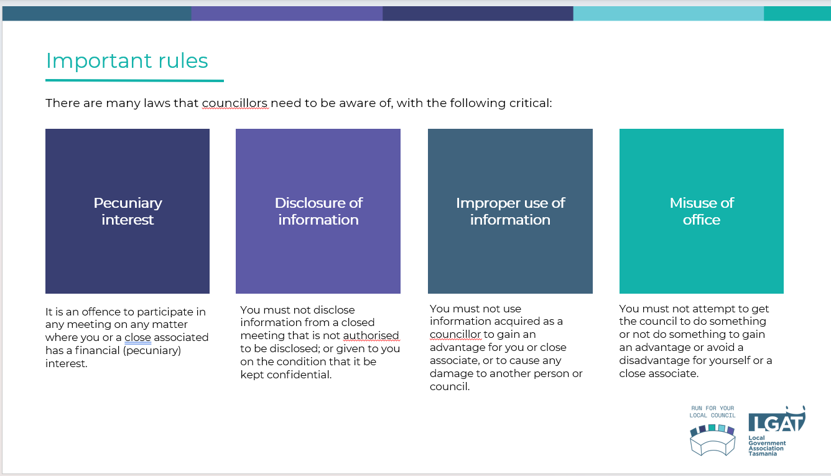
It is important to understand that the Local Government Act includes offences for Councillors that, if breached, carry significant penalties. You are expected to act lawfully, honestly and respectfully, treat others with courtesy, and contribute positively to a safe and constructive working environment. This includes your interactions with other Councillors, City of Clarence employees, contractors, stakeholders and members of the community.
It is recognised that Councillors may hold differing views and engage in robust debate, while maintaining respect for others and focusing on issues rather than individuals. Where concerns arise regarding conduct or behaviour, the Dispute Resolution Policy provides a framework to support an early and constructive resolution before matters escalate to a formal Code of Conduct complaint process.

Expected behaviour
As a Councillor, you are expected to contribute to a positive, respectful and collaborative governance environment. This includes listening to different perspectives, engaging in discussions respectfully, and working constructively with others even when opinions differ.
Behaviour that supports effective governance includes:
- being prepared for meetings
- communicating professionally
- respecting confidentiality requirements
- accepting collective decisions of Council
- treating others with fairness and respect.
You should strive to build productive working relationships with fellow Councillors and City of Clarence officers, recognising the distinct roles each plays in serving the community.
You should avoid behaviour that may undermine relationships, workplace wellbeing or public confidence in Council. This includes personal attacks, intimidation, disrespectful language, inappropriate comments, repeated disruptive behaviour, or conduct that creates an unsafe or hostile environment for others.
If disagreements arise, Councillors are encouraged to address issues respectfully and utilise the dispute resolution processes available to support positive outcomes and maintain effective working relationships.
Accountability and transparency
As a Councillor, you are accountable to the community you serve and are expected to carry out your role in a transparent, ethical and responsible manner.
This includes complying with legislative requirements, acting in accordance with Council policies and codes of conduct, and ensuring your decision-making can withstand public scrutiny – see Part 5A of the Local Government Act 1993.
You should familiarise yourself with your obligations regarding the declaration of gifts, benefits and other interests, and ensure any required disclosures are made in a timely manner.
To support transparency and maintain public confidence, City of Clarence maintains a Gifts and Donations Register.
Managing conflict of interest
As a Councillor, you are expected to act impartially and in the best interests of the Clarence community at all times.
It is important that you are aware of any actual, potential or perceived conflicts of interest that may arise in the course of your role and take appropriate steps to declare and manage them.
The management of pecuniary interests is governed by Part 5 of the Local Government Act 1993, while broader actual, potential and perceived conflicts of interest are addressed through the Tasmanian Local Government Code of Conduct (Part 2).
If you are ever uncertain about whether a conflict exists, you should seek advice from the Chief Executive Officer before participating in the matter.
Early disclosure and transparency help protect both you and Council’s decision-making processes.
The Local Government Association of Tasmania’s Councillor Handbook provides more information about expected behaviour, conflicts of interest, disclosure of information and misconduct.